
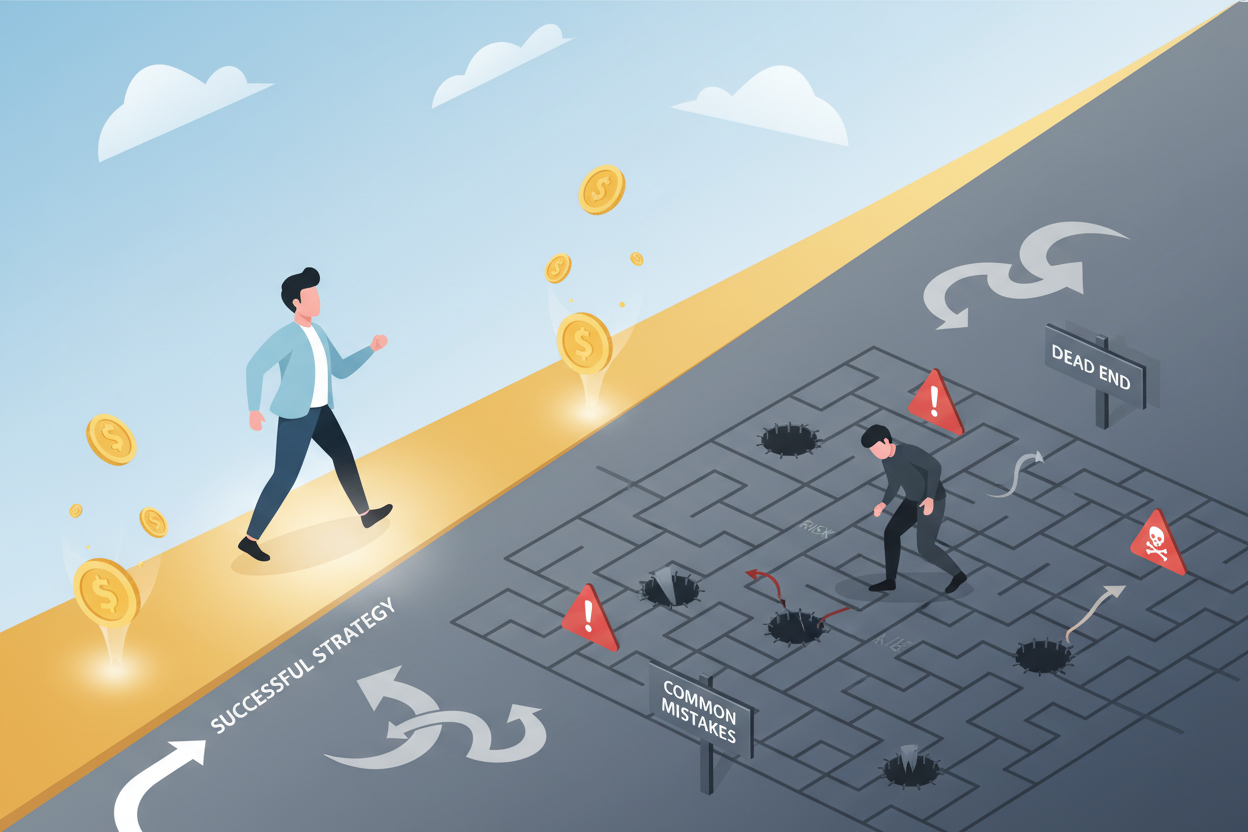
Avoiding Common Mistakes in Beginner Affiliate Marketing: Your Roadmap to Success 🚀
Table of Contents
1. Introduction: Why Most Affiliate Marketing Beginners Fail
2. Mistake #1: Choosing the Wrong Niche or Products
3. Mistake #2: Focusing Only on High Commission Rates
4. Mistake #3: Not Building Trust with Your Audience
5. Mistake #4: Ignoring SEO and Content Quality
6. Mistake #5: Expecting Overnight Success
7. Mistake #6: Not Tracking Performance and Analytics
8. Mistake #7: Violating FTC Guidelines and Disclosure Rules
9. How to Set Yourself Up for Affiliate Marketing Success
10. Frequently Asked Questions
11. Conclusion: Your Next Steps Forward

Introduction: Why Most Affiliate Marketing Beginners Fail 💭
Picture this: You’ve just discovered affiliate marketing, and you’re absolutely buzzing with excitement. The success stories are everywhere – people making thousands of dollars a month while sipping coffee on a beach somewhere exotic. You dive in headfirst, create your first affiliate links, and then… crickets. Sound familiar?
Here’s the thing I wish someone had told me when I started my affiliate marketing journey five years ago: failure isn’t inevitable, but it’s incredibly common among beginners. According to industry statistics, roughly 95% of affiliate marketers never earn more than a few dollars per month. But here’s the good news – most of these failures stem from easily avoidable mistakes.

Today, I’m going to walk you through the seven most common beginner affiliate marketing mistakes that could be sabotaging your success before you even get started. More importantly, I’ll show you exactly how to avoid them and set yourself up for long-term affiliate marketing success.
Mistake #1: Choosing the Wrong Niche or Products 🎯
One of the biggest mistakes I see new affiliate marketers make is jumping into whatever niche seems most profitable without considering their own interests, knowledge, or audience needs. I remember when I first started, I tried promoting weight loss supplements because the commissions looked amazing. The problem? I knew absolutely nothing about fitness or nutrition, and my lack of authenticity showed through every piece of content I created.
The truth is, successful affiliate marketing isn’t just about finding products with high demand – it’s about finding the sweet spot where market demand meets your genuine interest and expertise. When you’re passionate about what you’re promoting, it shows. Your content becomes more engaging, your recommendations feel more authentic, and your audience begins to trust you.
How to choose the right niche:
Start by making a list of topics you’re genuinely interested in or have experience with. Then, research whether there’s affiliate programs and audience demand in those areas. Tools like Google Trends, Amazon’s Best Sellers lists, and keyword research tools can help you validate your niche choice. Remember, it’s better to be a big fish in a small pond than a tiny fish in an ocean.
Don’t forget to consider the longevity of your chosen niche. Trending topics might offer quick wins, but established niches with consistent demand will serve you better in the long run. Think about whether you’d still be interested in creating content about this topic a year from now.
Mistake #2: Focusing Only on High Commission Rates 💰
I get it – when you see an affiliate program offering 50% commission, your eyes light up like a Christmas tree. But here’s what I learned the hard way: a high commission rate means nothing if you can’t actually sell the product.
Early in my affiliate marketing career, I promoted a high-ticket software program that offered incredible commissions. The problem was that the software was overpriced, had terrible reviews, and my audience simply wasn’t interested. Despite my best efforts, I made zero sales in three months of promotion.
Meanwhile, a friend of mine was promoting a lower-commission product that perfectly matched her audience’s needs. She was making consistent sales every week because she focused on value rather than commission rates.
What to focus on instead:
Look for products that offer genuine value to your audience. Consider factors like product quality, company reputation, customer support, and how well the product aligns with your audience’s needs. A 10% commission on a product that sells well is infinitely better than a 50% commission on something that never converts.
Also, consider the price point. Sometimes, lower-priced products with smaller commissions can generate more overall revenue because they’re easier to sell and have higher conversion rates.
Mistake #3: Not Building Trust with Your Audience 🤝
Trust is the currency of affiliate marketing, yet so many beginners treat their audience like walking wallets rather than real people with genuine needs and concerns. I cringe when I see new affiliate marketers plastering affiliate links everywhere without providing any real value or building relationships first.
Think about your own buying behavior. Do you purchase products from people you don’t trust? Of course not. Your audience is no different. They need to believe that you have their best interests at heart before they’ll click on your affiliate links.
Building trust takes time and consistency:
Share your personal experiences with products before recommending them. Be honest about both the pros and cons. If a product didn’t work for you or has limitations, say so. This transparency might seem counterintuitive, but it actually builds credibility.
Engage with your audience regularly. Respond to comments, answer questions, and show that there’s a real person behind your content. Share your story, your struggles, and your successes. People connect with authenticity, not perfection.
Provide value before asking for anything in return. Create helpful content, solve problems, and genuinely help your audience achieve their goals. When you consistently deliver value, recommending products feels natural rather than pushy.
Mistake #4: Ignoring SEO and Content Quality 📝
Content is still king in affiliate marketing, but many beginners treat it like an afterthought. They create thin, low-quality content stuffed with affiliate links and wonder why they’re not getting traffic or conversions.
I learned this lesson when Google completely de-indexed my first affiliate website. I had been creating short, keyword-stuffed articles that provided little value to readers. It was a wake-up call that forced me to completely rethink my content strategy.
Creating content that ranks and converts:
Focus on solving real problems for your audience. Every piece of content should answer a specific question or address a particular pain point. Use keyword research tools to understand what your audience is searching for, but don’t sacrifice readability for keyword density.
Aim for comprehensive, in-depth content that thoroughly covers your topic. Google favors content that demonstrates expertise, authority, and trustworthiness (E-A-T). This means doing your research, citing credible sources, and providing unique insights based on your experience.
Don’t forget about user experience. Your content should be easy to read, well-formatted, and mobile-friendly. Use headings, bullet points, and images to break up large blocks of text. The longer people stay on your page, the better it signals to search engines that your content is valuable.
Mistake #5: Expecting Overnight Success ⏰
Perhaps the most dangerous mistake beginners make is expecting immediate results. Social media is flooded with “get rich quick” affiliate marketing schemes that promise thousands of dollars in your first month. These unrealistic expectations lead to disappointment and cause many promising affiliate marketers to quit before they see results.
Let me be brutally honest: affiliate marketing is not a get-rich-quick scheme. It’s a legitimate business model that requires time, effort, and patience to build. My first affiliate commission was $3.47, and it came three months after I started. But that small victory motivated me to keep going, and within a year, I was earning consistent monthly income.
Setting realistic expectations:
Most successful affiliate marketers don’t see significant income for at least 6-12 months. This timeline allows you to build an audience, create quality content, and establish trust. Instead of focusing on immediate income, focus on metrics like website traffic, email subscribers, and engagement rates.
Celebrate small wins along the way. Your first website visitor, your first email subscriber, your first affiliate click – these are all important milestones that indicate you’re moving in the right direction.
Mistake #6: Not Tracking Performance and Analytics 📊
Flying blind is one of the fastest ways to fail in affiliate marketing. Many beginners create content, share affiliate links, and hope for the best without tracking what’s actually working. This approach makes it impossible to optimize your strategy or scale your successes.
I used to be guilty of this myself. I would promote products across different platforms without tracking which channels were driving conversions. It wasn’t until I started diving deep into analytics that I discovered most of my sales were coming from email marketing, not social media as I had assumed.
Essential metrics to track:
Monitor your click-through rates, conversion rates, and earnings per click for each affiliate program. Use tools like Google Analytics to understand your traffic sources and user behavior. Most affiliate networks provide detailed reporting – actually use it!
Track which types of content perform best. Are your product reviews converting better than comparison posts? Do videos drive more clicks than written content? This data helps you focus your efforts on what’s actually working.
Don’t forget to track your expenses too. Factor in costs for hosting, tools, advertising, and your time investment. Understanding your true profit margins helps you make better business decisions.
Mistake #7: Violating FTC Guidelines and Disclosure Rules ⚖️
This might seem like a boring topic, but ignoring FTC guidelines can seriously damage your credibility and even result in legal issues. The Federal Trade Commission requires clear and conspicuous disclosure of affiliate relationships, yet many beginners either ignore this requirement or bury their disclosures where no one can find them.
I’ve seen affiliate marketers lose their audiences’ trust overnight when people discovered undisclosed affiliate relationships. Transparency isn’t just legally required – it’s good business practice.
Staying compliant:
Always disclose your affiliate relationships clearly and prominently. Use simple language like “This post contains affiliate links” or “I may earn a commission if you purchase through my links.” Place these disclosures at the beginning of your content, not buried at the bottom.
Be honest about your experiences with products. Don’t claim to have used something if you haven’t, and don’t exaggerate benefits or downplay drawbacks. Your reputation is worth more than any single commission.
How to Set Yourself Up for Affiliate Marketing Success 🌟
Now that we’ve covered what not to do, let’s talk about setting yourself up for success. The key is to approach affiliate marketing as a real business, not a side hustle you can ignore.
Start with a solid foundation:
Choose a niche you’re passionate about and research it thoroughly. Understand your target audience’s pain points, desires, and buying behavior. Create a content calendar and commit to publishing consistently, even if it’s just once a week initially.
Invest in the right tools and education. While you don’t need to break the bank, having a professional website, email marketing platform, and analytics tools will set you apart from hobbyists. Consider taking a reputable affiliate marketing course or joining a community of serious marketers.
Focus on building relationships:
Remember that successful affiliate marketing is about building relationships, not just driving traffic. Engage with your audience, provide value consistently, and always prioritize their needs over your commission potential.
Network with other affiliate marketers and industry professionals. Join relevant Facebook groups, attend virtual conferences, and don’t be afraid to reach out to successful marketers in your niche. The affiliate marketing community is generally supportive and willing to help newcomers who show genuine commitment.
Frequently Asked Questions 🤔
Q: How long does it take to make money with affiliate marketing?
A: Most successful affiliate marketers start seeing consistent income between 6-12 months after starting. However, this timeline can vary significantly based on your niche, content quality, marketing strategy, and time investment. Some see results sooner, while others may take longer to build momentum.
Q: Do I need a website to start affiliate marketing?
A: While it’s possible to do affiliate marketing through social media alone, having a website gives you more control over your content and audience. It also appears more professional and trustworthy to potential customers. A website serves as your home base where you own the traffic and aren’t dependent on algorithm changes.
Q: How many affiliate programs should I join as a beginner?
A: Start small with 2-3 high-quality affiliate programs that align well with your niche and audience. It’s better to deeply understand and effectively promote a few products than to spread yourself thin across many programs. You can always expand later as you gain experience.
Q: Is it better to focus on physical products or digital products?
A: Both have their advantages. Physical products often have higher conversion rates because people are familiar with buying them, but commissions are typically lower. Digital products usually offer higher commissions but may have lower conversion rates. Choose based on what makes sense for your audience and niche.
Q: How much money do I need to start affiliate marketing?
A: You can start affiliate marketing with a minimal budget – as little as $100-200 for basic website hosting and domain registration. However, having a budget for tools, education, and potentially paid advertising can accelerate your progress significantly.
Conclusion: Your Next Steps Forward 🎯
Affiliate marketing success isn’t about avoiding every possible mistake – it’s about learning from the most common ones and building a sustainable strategy that puts your audience first. The seven mistakes we’ve covered today have derailed countless affiliate marketing careers, but they’re all completely avoidable with the right knowledge and approach.
Remember, every successful affiliate marketer started exactly where you are now. The difference between those who succeed and those who give up isn’t talent or luck – it’s persistence, continuous learning, and a genuine commitment to providing value to their audience.
Your affiliate marketing journey won’t always be smooth, and you’ll likely make some mistakes along the way. That’s perfectly normal and part of the learning process. The key is to start with realistic expectations, focus on building trust with your audience, and consistently create valuable content that serves their needs.
Take action today by choosing your niche thoughtfully, setting up proper tracking from the beginning, and committing to the long-term process of building a successful affiliate marketing business. Your future self will thank you for starting with the right foundation rather than having to rebuild later.
The affiliate marketing landscape is constantly evolving, but the fundamentals of providing value, building trust, and serving your audience will never go out of style. Focus on these principles, avoid the common pitfalls we’ve discussed, and you’ll be well on your way to affiliate marketing success. 🚀
Number 1 Money earning platform
Hit the button to check our number one recommended product






0 Comments